🎉 Up to 70% Off Selected ItemsShop Sale
HomeStore
Victorian 1910 Triangular Art Nouveau Nippon Dish Tray Hand Painted Modern Raised Embellishments
Victorian 1910 Triangular Art Nouveau Nippon Dish Tray Hand Painted Modern Raised Embellishments
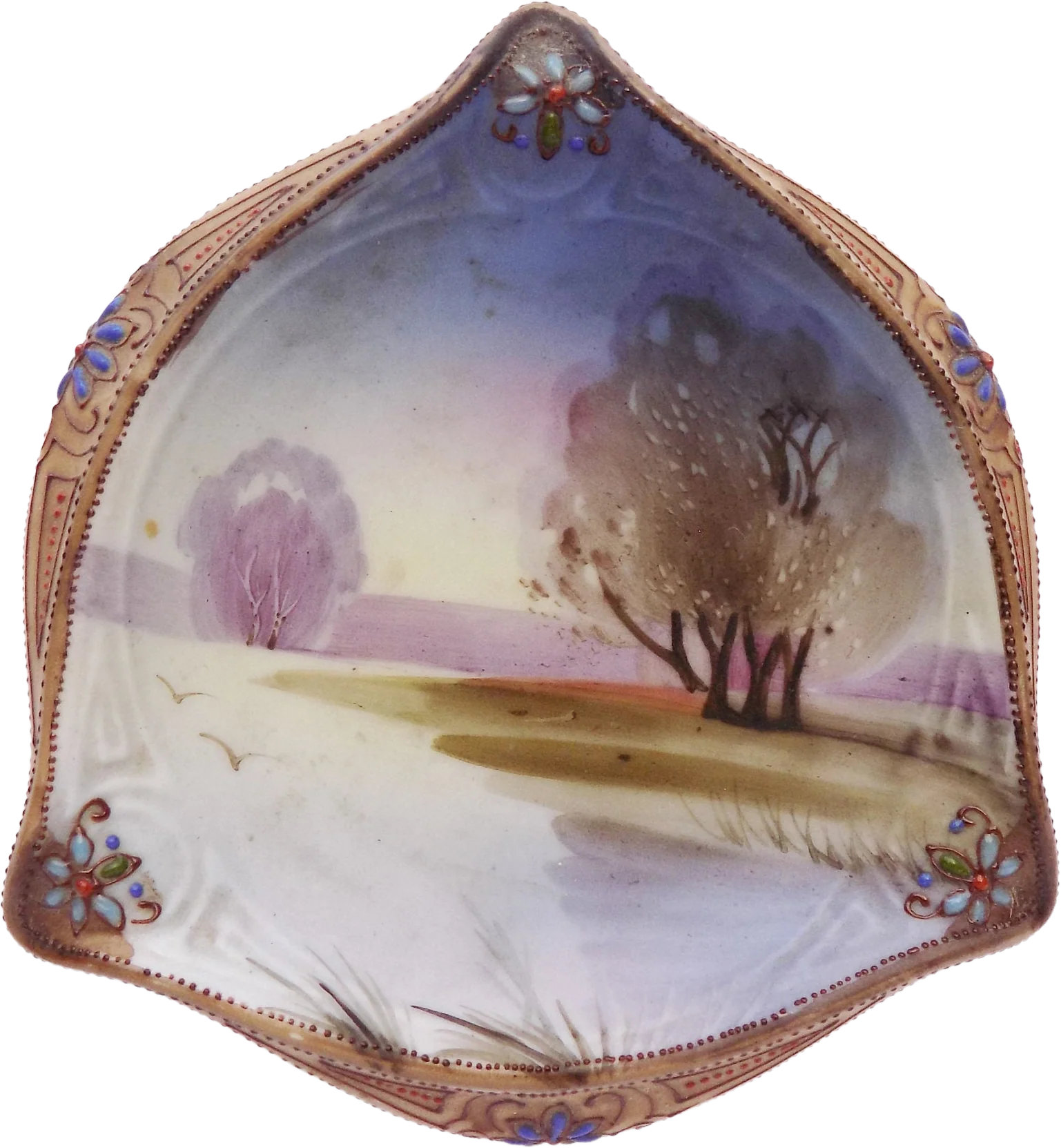
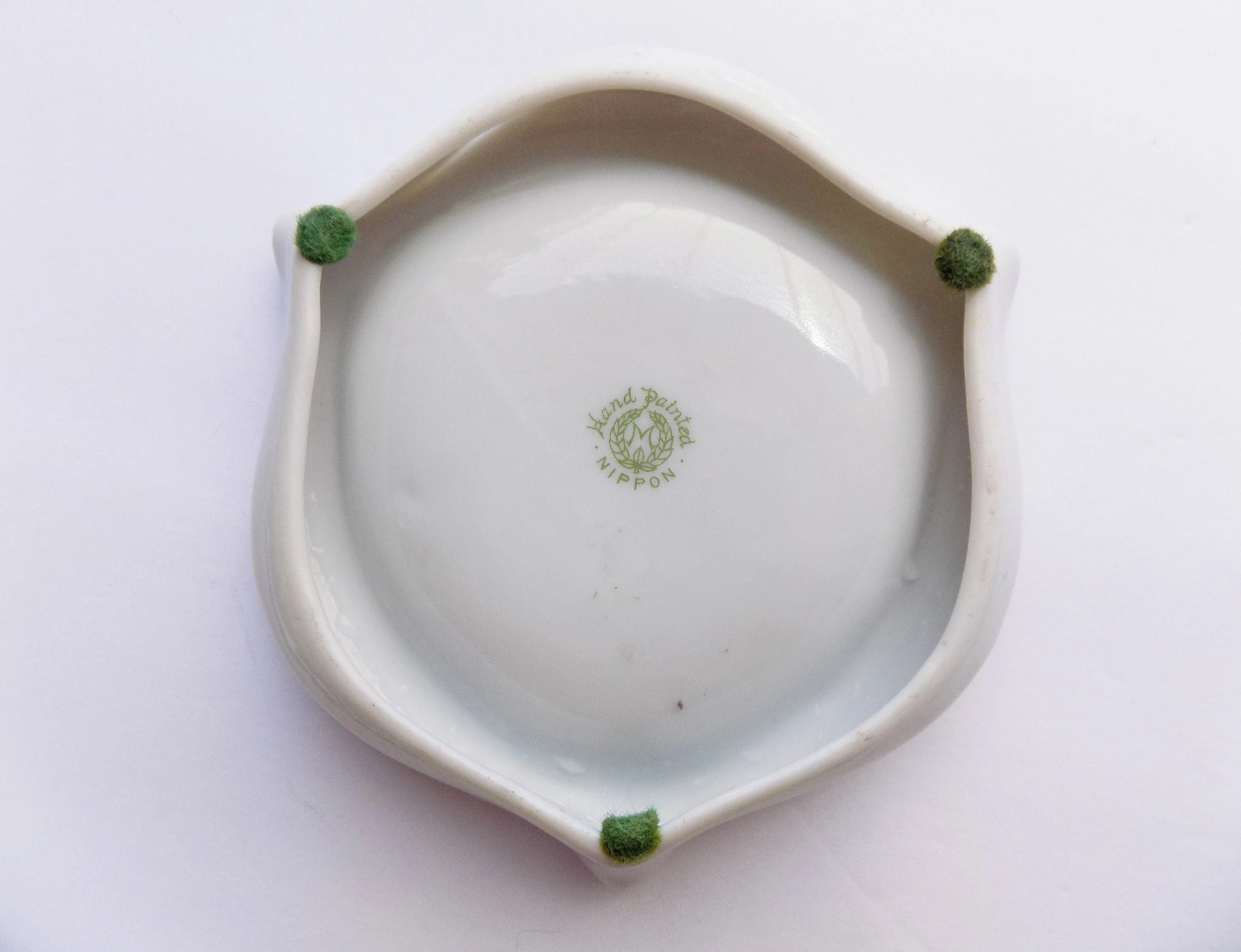
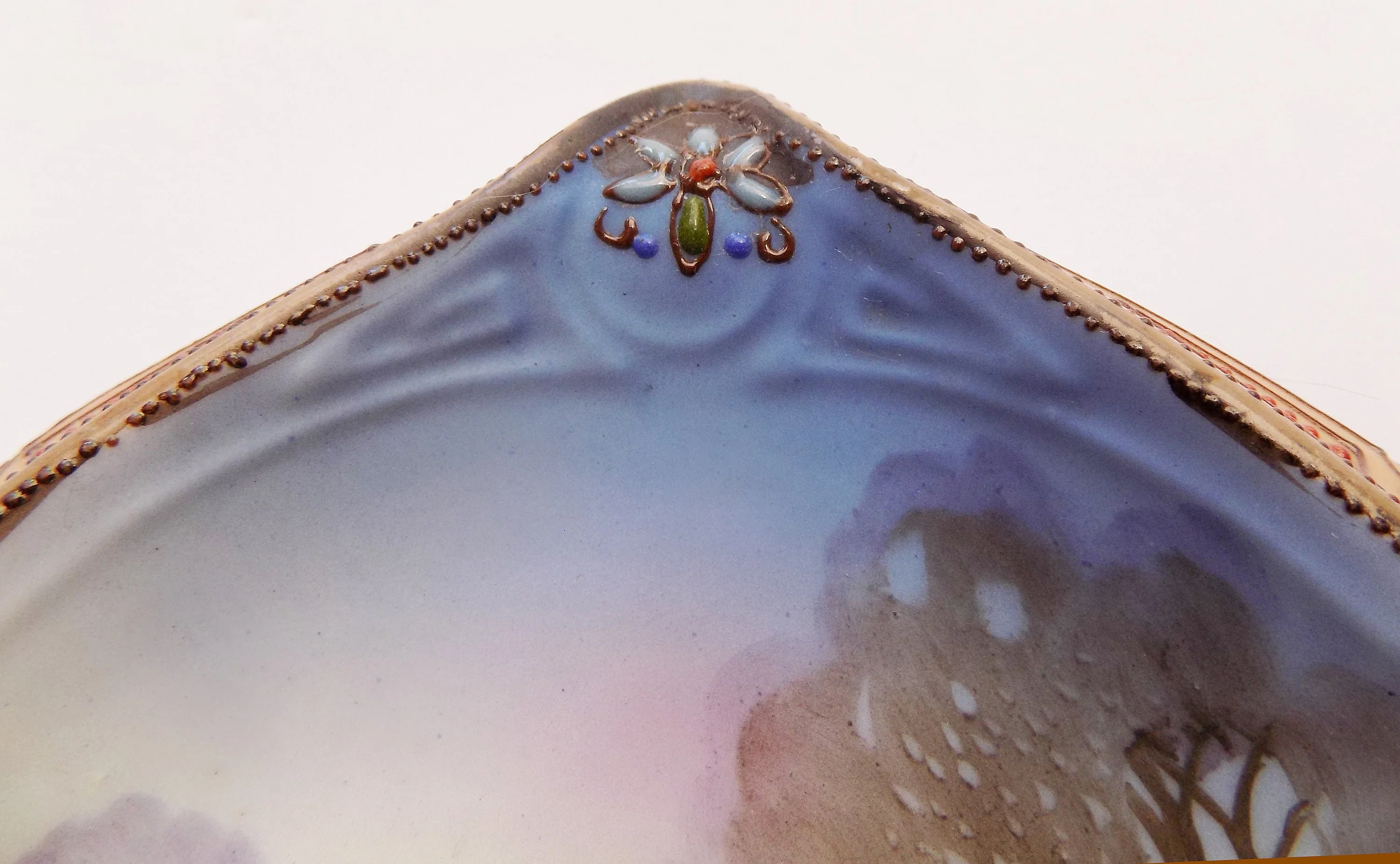
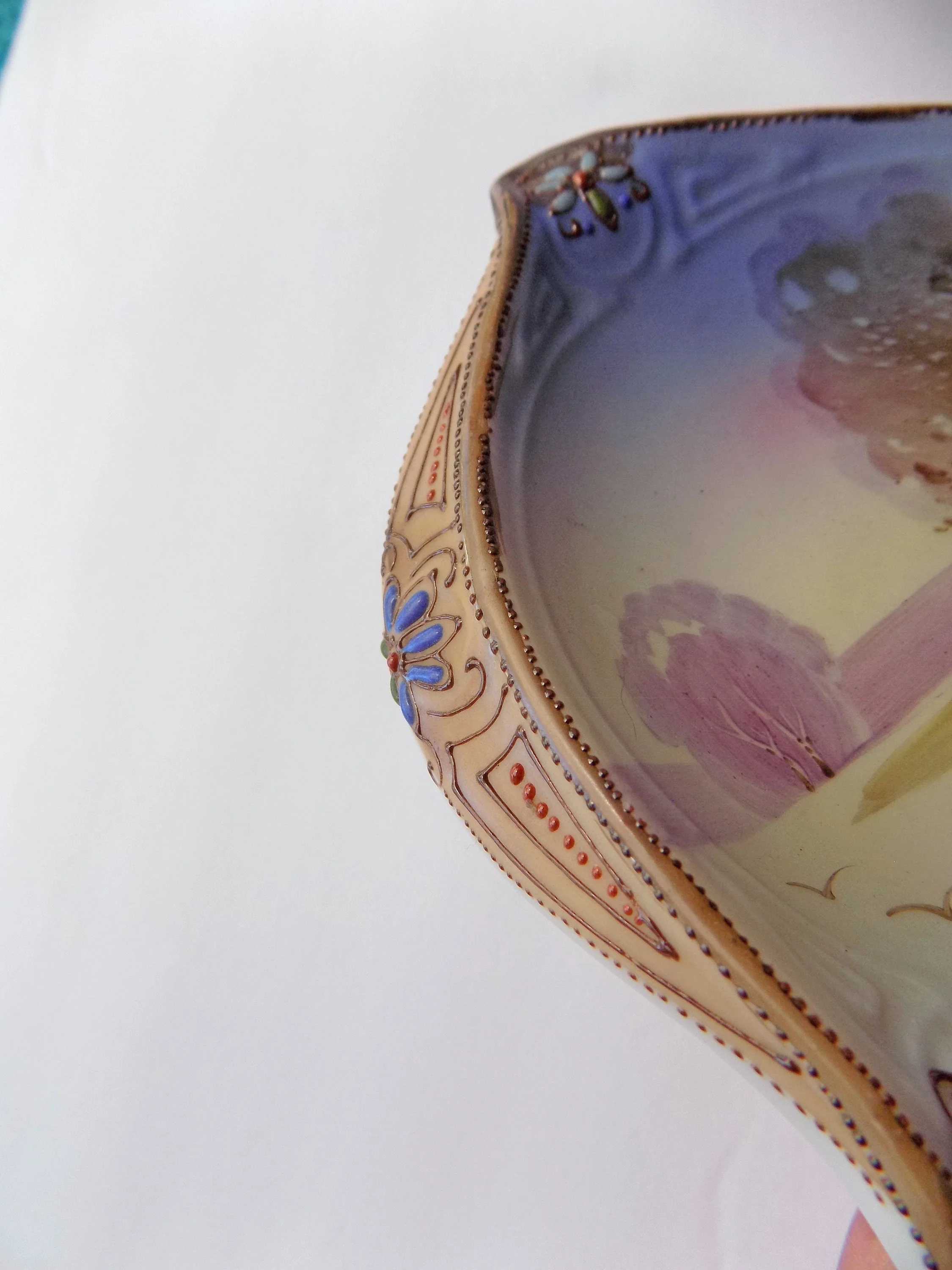
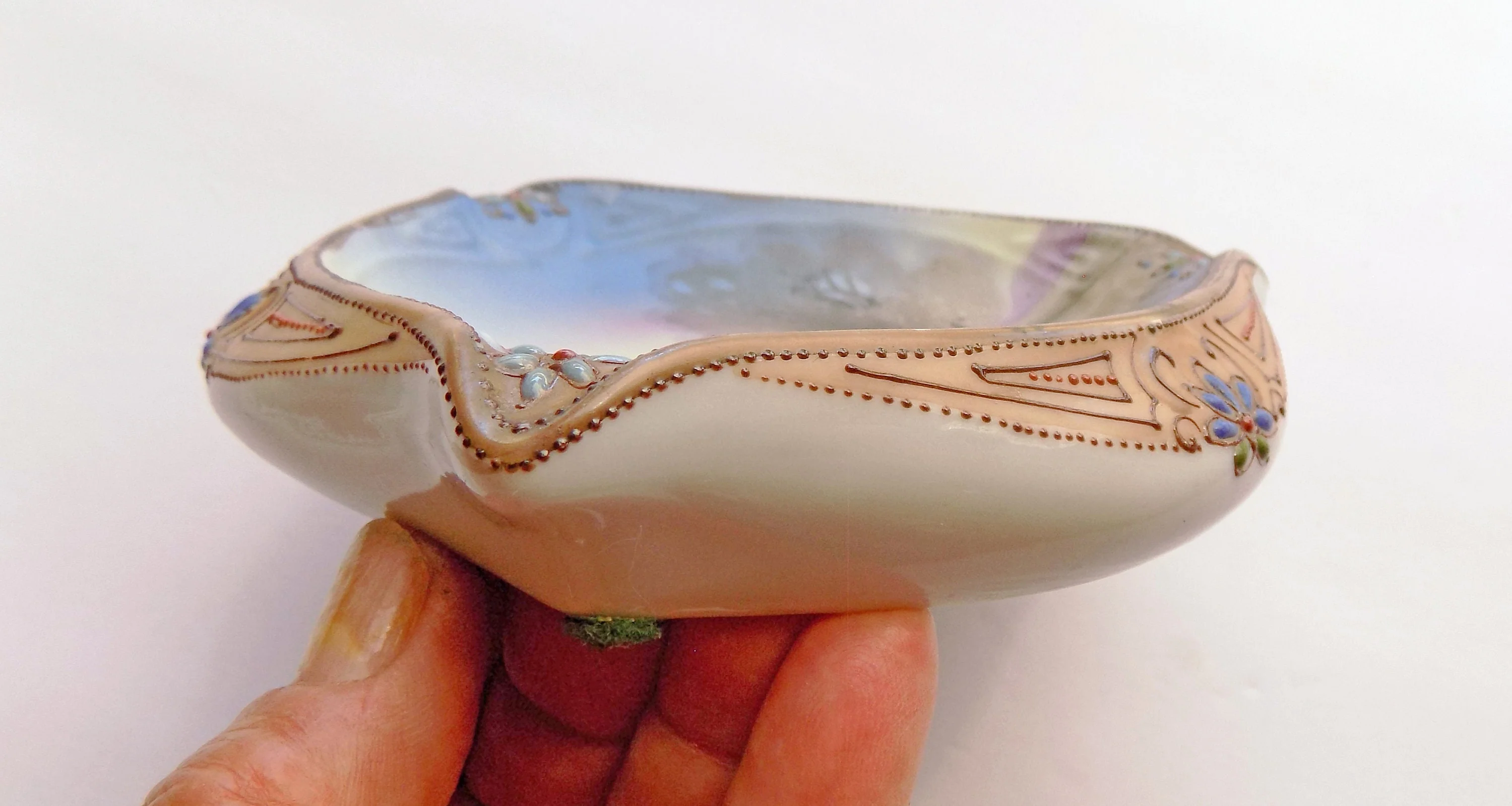
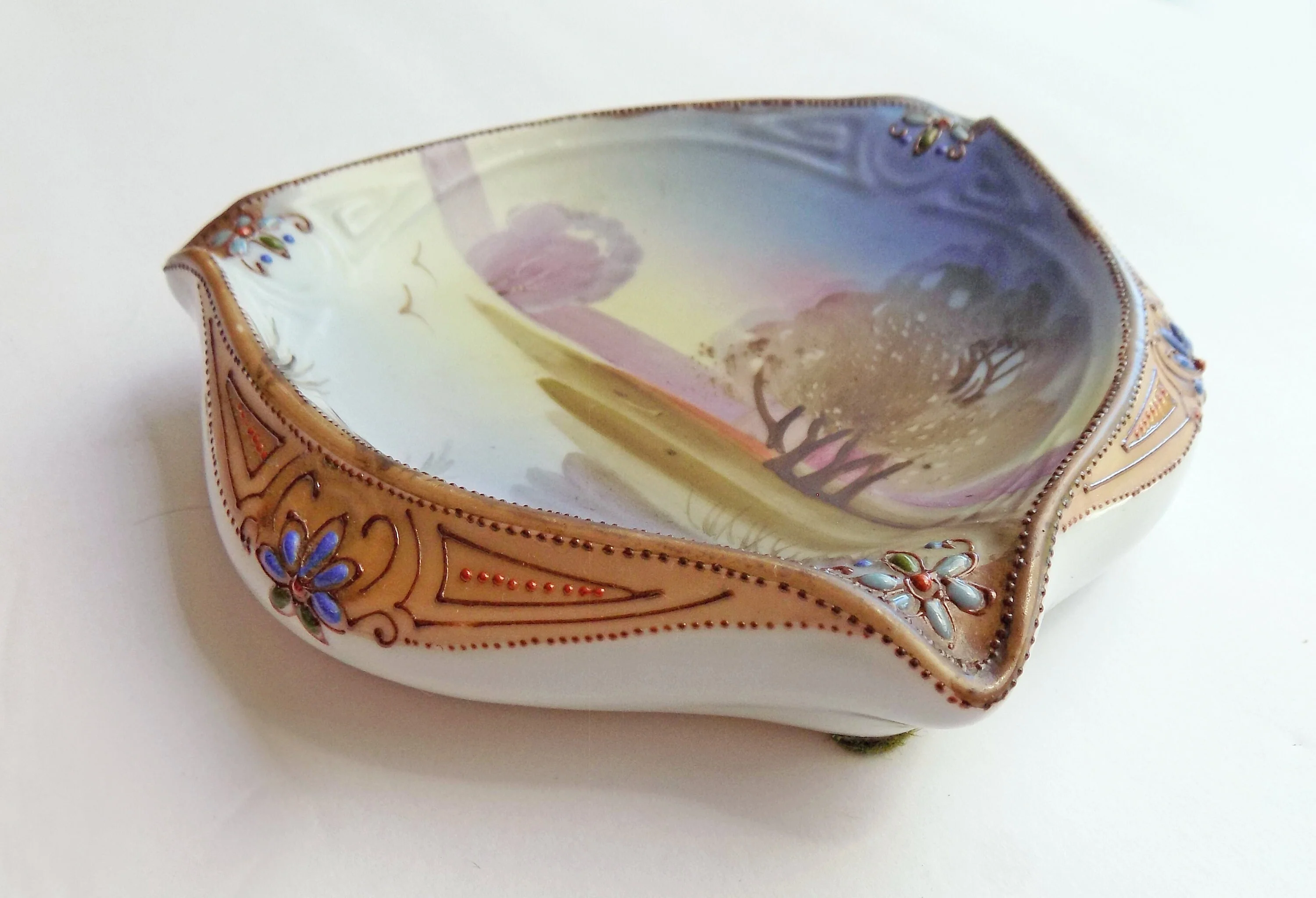
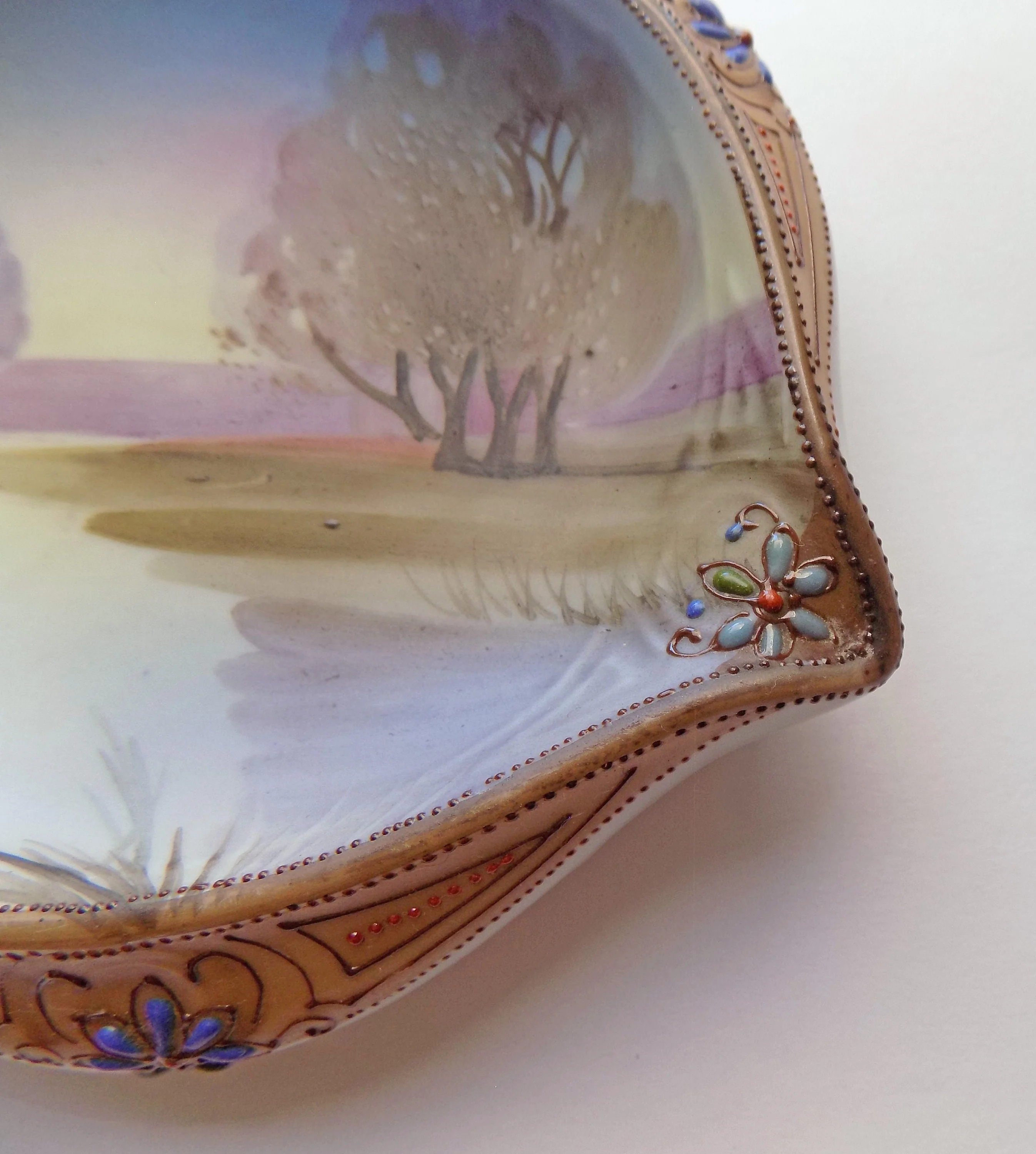
I REALLY love Art Nouveau, so when I saw this beautifully hand painted dish, I had to take it home with me. It is so hard to find these pieces in good condition, so I only have about 3 things that fall into this category of design. I have had a Nippon piece or two, but this seems to be an unusual piece. I just did a Nippon tray/dish search, and can't find anything that is this shape. I don't think it is an ashtray, because the cigarette slots are not clearly defined. I don't know what you call the raised style of painting, but al the dots and the flowers that edge the dish are raised. The scene seems to be by a lake with large trees. Two low flying birds off set the composition. Three little felt pads buffer the bottom of the dish, to protect any wood table tops. No flaws! Measures 5. 25" across, and is 1 inch deep.
Here is more info about the Art Nouveau movement: ( Wikipedia)
It was often inspired by natural forms such as the sinuous curves of plants and flowers.[2] Other characteristics of Art Nouveau were a sense of dynamism and movement, often given by asymmetry or whiplash lines, and the use of modern materials, particularly iron, glass, ceramics and later concrete, to create unusual forms and larger open spaces.[3]
One major objective of Art Nouveau was to break down the traditional distinction between fine arts (especially painting and sculpture) and applied arts. It was most widely used in interior design, graphic arts, furniture, glass art, textiles, ceramics, jewelry and metal work. The style responded to leading 19-century theoreticians, such as French architect Eugène-Emmanuel Viollet-le-Duc (1814–1879) and British art critic John Ruskin (1819–1900). In Britain, it was influenced by William Morris and the Arts and Crafts movement. German architects and designers sought a spiritually uplifting Gesamtkunstwerk ("total work of art") that would unify the architecture, furnishings, and art in the interior in a common style, to uplift and inspire the residents.[3]
Here is more info about the Art Nouveau movement: ( Wikipedia)
It was often inspired by natural forms such as the sinuous curves of plants and flowers.[2] Other characteristics of Art Nouveau were a sense of dynamism and movement, often given by asymmetry or whiplash lines, and the use of modern materials, particularly iron, glass, ceramics and later concrete, to create unusual forms and larger open spaces.[3]
One major objective of Art Nouveau was to break down the traditional distinction between fine arts (especially painting and sculpture) and applied arts. It was most widely used in interior design, graphic arts, furniture, glass art, textiles, ceramics, jewelry and metal work. The style responded to leading 19-century theoreticians, such as French architect Eugène-Emmanuel Viollet-le-Duc (1814–1879) and British art critic John Ruskin (1819–1900). In Britain, it was influenced by William Morris and the Arts and Crafts movement. German architects and designers sought a spiritually uplifting Gesamtkunstwerk ("total work of art") that would unify the architecture, furnishings, and art in the interior in a common style, to uplift and inspire the residents.[3]
$80.00
Victorian 1910 Triangular Art Nouveau Nippon Dish Tray Hand Painted Modern Raised Embellishments—
$80.00
More Images
Victorian 1910 Triangular Art Nouveau Nippon Dish Tray Hand Painted Modern Raised Embellishments
I REALLY love Art Nouveau, so when I saw this beautifully hand painted dish, I had to take it home with me. It is so hard to find these pieces in good condition, so I only have about 3 things that fall into this category of design. I have had a Nippon piece or two, but this seems to be an unusual piece. I just did a Nippon tray/dish search, and can't find anything that is this shape. I don't think it is an ashtray, because the cigarette slots are not clearly defined. I don't know what you call the raised style of painting, but al the dots and the flowers that edge the dish are raised. The scene seems to be by a lake with large trees. Two low flying birds off set the composition. Three little felt pads buffer the bottom of the dish, to protect any wood table tops. No flaws! Measures 5. 25" across, and is 1 inch deep.
Here is more info about the Art Nouveau movement: ( Wikipedia)
It was often inspired by natural forms such as the sinuous curves of plants and flowers.[2] Other characteristics of Art Nouveau were a sense of dynamism and movement, often given by asymmetry or whiplash lines, and the use of modern materials, particularly iron, glass, ceramics and later concrete, to create unusual forms and larger open spaces.[3]
One major objective of Art Nouveau was to break down the traditional distinction between fine arts (especially painting and sculpture) and applied arts. It was most widely used in interior design, graphic arts, furniture, glass art, textiles, ceramics, jewelry and metal work. The style responded to leading 19-century theoreticians, such as French architect Eugène-Emmanuel Viollet-le-Duc (1814–1879) and British art critic John Ruskin (1819–1900). In Britain, it was influenced by William Morris and the Arts and Crafts movement. German architects and designers sought a spiritually uplifting Gesamtkunstwerk ("total work of art") that would unify the architecture, furnishings, and art in the interior in a common style, to uplift and inspire the residents.[3]
Here is more info about the Art Nouveau movement: ( Wikipedia)
It was often inspired by natural forms such as the sinuous curves of plants and flowers.[2] Other characteristics of Art Nouveau were a sense of dynamism and movement, often given by asymmetry or whiplash lines, and the use of modern materials, particularly iron, glass, ceramics and later concrete, to create unusual forms and larger open spaces.[3]
One major objective of Art Nouveau was to break down the traditional distinction between fine arts (especially painting and sculpture) and applied arts. It was most widely used in interior design, graphic arts, furniture, glass art, textiles, ceramics, jewelry and metal work. The style responded to leading 19-century theoreticians, such as French architect Eugène-Emmanuel Viollet-le-Duc (1814–1879) and British art critic John Ruskin (1819–1900). In Britain, it was influenced by William Morris and the Arts and Crafts movement. German architects and designers sought a spiritually uplifting Gesamtkunstwerk ("total work of art") that would unify the architecture, furnishings, and art in the interior in a common style, to uplift and inspire the residents.[3]
Product Information
Product Information
Shipping & Returns
Shipping & Returns
Description
I REALLY love Art Nouveau, so when I saw this beautifully hand painted dish, I had to take it home with me. It is so hard to find these pieces in good condition, so I only have about 3 things that fall into this category of design. I have had a Nippon piece or two, but this seems to be an unusual piece. I just did a Nippon tray/dish search, and can't find anything that is this shape. I don't think it is an ashtray, because the cigarette slots are not clearly defined. I don't know what you call the raised style of painting, but al the dots and the flowers that edge the dish are raised. The scene seems to be by a lake with large trees. Two low flying birds off set the composition. Three little felt pads buffer the bottom of the dish, to protect any wood table tops. No flaws! Measures 5. 25" across, and is 1 inch deep.
Here is more info about the Art Nouveau movement: ( Wikipedia)
It was often inspired by natural forms such as the sinuous curves of plants and flowers.[2] Other characteristics of Art Nouveau were a sense of dynamism and movement, often given by asymmetry or whiplash lines, and the use of modern materials, particularly iron, glass, ceramics and later concrete, to create unusual forms and larger open spaces.[3]
One major objective of Art Nouveau was to break down the traditional distinction between fine arts (especially painting and sculpture) and applied arts. It was most widely used in interior design, graphic arts, furniture, glass art, textiles, ceramics, jewelry and metal work. The style responded to leading 19-century theoreticians, such as French architect Eugène-Emmanuel Viollet-le-Duc (1814–1879) and British art critic John Ruskin (1819–1900). In Britain, it was influenced by William Morris and the Arts and Crafts movement. German architects and designers sought a spiritually uplifting Gesamtkunstwerk ("total work of art") that would unify the architecture, furnishings, and art in the interior in a common style, to uplift and inspire the residents.[3]
Here is more info about the Art Nouveau movement: ( Wikipedia)
It was often inspired by natural forms such as the sinuous curves of plants and flowers.[2] Other characteristics of Art Nouveau were a sense of dynamism and movement, often given by asymmetry or whiplash lines, and the use of modern materials, particularly iron, glass, ceramics and later concrete, to create unusual forms and larger open spaces.[3]
One major objective of Art Nouveau was to break down the traditional distinction between fine arts (especially painting and sculpture) and applied arts. It was most widely used in interior design, graphic arts, furniture, glass art, textiles, ceramics, jewelry and metal work. The style responded to leading 19-century theoreticians, such as French architect Eugène-Emmanuel Viollet-le-Duc (1814–1879) and British art critic John Ruskin (1819–1900). In Britain, it was influenced by William Morris and the Arts and Crafts movement. German architects and designers sought a spiritually uplifting Gesamtkunstwerk ("total work of art") that would unify the architecture, furnishings, and art in the interior in a common style, to uplift and inspire the residents.[3]